 Game
Does Scourge of the Necromancer use AI?
Most visual assets, all music and sound effects, and the Necromancer's voice are AI-generated, with human editing and curation throughout.
Our AI review, high confidence. Not a verdict; the evidence is below.
Checked against Steam on Oct 28, 2026.
Before you buy: anti-cheat, accounts, DRM
No anti-cheat, third-party account or DRM is declared on Scourge of the Necromancer's Steam page.
Full anti-cheat, account and DRM details, with change history →
Production signals
Facts about who made the game and how players received it. They don't depend on AI, and they help tell a carefully made game that used some AI apart from mass-produced ones.
- Ember Logic LLC released 1 game on Steam in the last 12 months. 1 of their 1 game disclose AI.
- This is the developer's first game on Steam.
- Few players: released 3 months ago with no reviews.
- Our AI review of these signals: mixed signals.
What the developer says
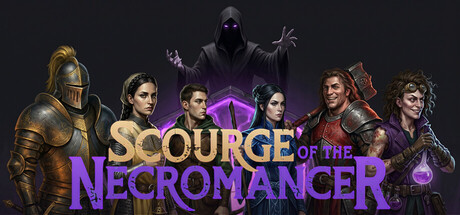
Scourge of the Necromancer makes significant use of generative AI in its production. We want to be fully upfront about it. Visual assets (2D images + video) — all AI-generated, then human-curated and human-edited. Every shipped image and video in the game and on the Steam store page was produced with AI tools, then reviewed, edited, and selected by hand by the developer. This covers: Steam store capsules and library art, the store-page background, all in-game achievement icons, hero portraits, the Necromancer concept art, decorative UI elements, all real-time cinematics (the defeat sequence and all victory variants), and the marketing trailer's atmospheric segments. Image models used: Google Imagen 4, Google Veo 3.1 (video), Nano Banana Pro / Gemini 3 Pro Image (Google), Black Forest Labs FLUX.2, Recraft V4 Pro, Ideogram V3, and Bria RMBG-2.0 (background removal). Final assets received human editing — compositing, color correction, retouching, frame extraction, masking, and rejection of unusable outputs. 3D models — AI-generated base meshes, then human-edited in Blender. The in-game hero character models (Knight, Cleric, Ranger, Wizard, Warrior, Alchemist) started as outputs from Tripo AI's generative 3D model service (FBX + texture PNGs), but each model was then opened in Blender by the developer for hand editing — mesh cleanup, geometry adjustments, and texture fixes — before being exported for use in the game. Each finished model was imported into Unity with hand-tuned scale, rotation, material configuration, and import-setting curation. Unsatisfactory generations were discarded and re-prompted; the Blender editing step is substantial enough that the shipped models are not pure AI output. Music — AI-generated, then human-curated and post-processed. All music tracks in the game (menu, gameplay layers, boss phases, victory, defeat) were produced with Google Gemini's music generation, then human-selected, trimmed, looped, and mixed by the developer. Necromancer voice — AI-generated, then human-edited. The Necromancer's spoken syllables were synthesized with ElevenLabs Text-to-Speech (Eleven Multilingual v2 model), then pitch-shifted, EQ'd, and processed with reverb in Audacity by the developer to produce the final in-game delivery. No other character has spoken voice lines in the shipped game. Sound effects — all AI-generated. Every SFX in the game (ability sounds, ambient layers, UI sounds, footsteps, kill/spawn cues, tile state cues, boss audio) was produced with ElevenLabs Sound Effects, then human-selected, trimmed, processed, and mixed by the developer. The Necromancer voice lines use ElevenLabs Text-to-Speech (covered separately above). Runtime behavior. The game does NOT use live-generated AI content at runtime. Every shipped asset is a fixed, pre-rendered file. Player-facing text, dialogue, narrative, lore, and game design were written by the developer without AI generation. Code. Code development used Claude (Anthropic) as an AI coding assistant. This is behind-the-scenes efficiency tooling not consumed by players, but we mention it here for full transparency.
From the “AI Generated Content Disclosure” on the Steam store page, quoted as written. First seen by us on Oct 28, 2026.
What other sources say
| Source | Their take |
|---|---|
| Steam disclosure | AI content disclosed |
| AI judgment deepseek-flash | Major AI · mixed signals, high confidenceReasoningThe disclosure states all shipped images, video, music, and sound effects are AI-generated, plus AI base meshes for hero models and AI voice for the Necromancer. Writing, design, and code are human-authored, and assets received substantial human editing. Only one game released in the last 12 months, so volume signals don't support mass-produced. Against: Developer describes extensive human curation and editing of AI outputs, and no runtime AI generation; only one release, not a high-volume pattern. |
| Remove AI Slop open-source extension | Mostly AI-generated (art, marketing, translation, concept/reference, music/sound, UI/icons, voice, code) |
FAQ
Does Scourge of the Necromancer use AI?
Yes. Scourge of the Necromancer's developer discloses AI-generated content on its Steam page. Most visual assets, all music and sound effects, and the Necromancer's voice are AI-generated, with human editing and curation throughout.
Is Scourge of the Necromancer AI-generated?
AI-generated content makes up a major part of the game, according to its disclosure.
How does GameAICheck know?
We read the AI Generated Content Disclosure from the game's public Steam store page, check it daily, and show what independent curators and open-source tools say about it. Disclosures are self-reported by developers.
Is something wrong?
Developers and players can dispute or report this page. We review every message and correct mistakes.